
SS8-60HD-485N

485 Wp N-type Bifacial 80%
ComparePV verdict

Solid all-round for its segment

Rank 7,275 of 14,005
Compare panels Datasheet PDF
Power (Wp)
485
Strong · top 23%
Efficiency (%)
22.40
Typical · median 22.52%
Density (Wp/m²)
224.0
Typical · median 225.2
Temp (%/°C)
-0.290
Typical · median -0.290
Weight (kg)
25.0
Typical · median 23.7 kg
Warranty (yrs)
30
Typical · median 30 yrs

The Solarspace SS8-60HD 470-495N series is designed to maximize energy yield in situations where every square meter counts. The use of N-type cells allows for minimizing typical power losses over time and maintaining high operational efficiency for many seasons. Furthermore, the bifacial design can utilize reflected light from the ground, which significantly improves production on roofs with light-colored surfaces and on ground-mounted installations.

The half-cut architecture also deserves attention, as it reduces resistive losses and improves the module's performance under partial shading - which is particularly important on roofs with chimneys, skylights, or east-west facing installations. The anti-reflective glass layer supports stable operation in low-light conditions, while the high IP rating (IP68) increases resistance to moisture and harsh operating conditions.

This is a good choice for homes, businesses, and PV farms that require predictable production and long-term reliability without compromising on performance.

Ranking

301 panels in the segment N-type 450-500 W
Metric This panel Median Position in segment Overall rank
Module efficiency 22.40% 22.52% Typical 4,774
Power density 224.0 225.2 Typical 4,769
Temperature coefficient -0.290 -0.290 Typical 2,165
Weight per kWp 51.5 49.5 Typical 4,932
Performance warranty 30 yrs 30 yrs Typical 21
Colour key Strong - top 25% Typical - middle 50% Weak - bottom 25%

Signals from the data

0 positive · 0 caution
Best for

Residential, commercial and shaded-installations.

Notes from the database
  • Efficiency of 22.4% matches the N-type 450-500W median
  • At 224.0 W/m² power density, roof space requirements are typical for N-type 450-500W panels
  • Temperature coefficient of -0.29%/°C matches the N-type 450-500W median
  • At 25.0 kg, this panel is 1.3 kg heavier than the N-type 450-500W median (23.7 kg) - more demanding for installation crews
  • Bifacial design (80% factor) captures reflected light - adds 4-12% yield on ground-mount or white roof

Specifications

Open datasheet PDF
Nominal power (Pmax) 485 Wp Nameplate at 1000 W/m², 25 °C
Module efficiency 22.40 % Typical Segment median 22.52%
Vmpp · Impp 35.51 V · 13.66 A Operating point at max power
Voc · Isc 42.85 V · 14.40 A Sizes the string length
Max system voltage 1500 V Longer strings than 1000 V modules
Dimensions 1909×1134×30 mm · 2.16 m² of roof
Weight 25.0 kg Typical Typical · median 23.7 kg
Cells 120 · N-type Monocrystalline
Bifaciality 80 % Rear output as a share of front
Coefficient Pmax -0.290 %/°C Typical median -0.290 of its segment
Coefficient Voc · Isc -0.260 · 0.045 %/°C
NOCT 45 °C At 800 W/m², 20 °C ambient
Product warranty 15 years Hardware defects only
Performance warranty 30 years Typical median 30 yrs · median 30 yrs
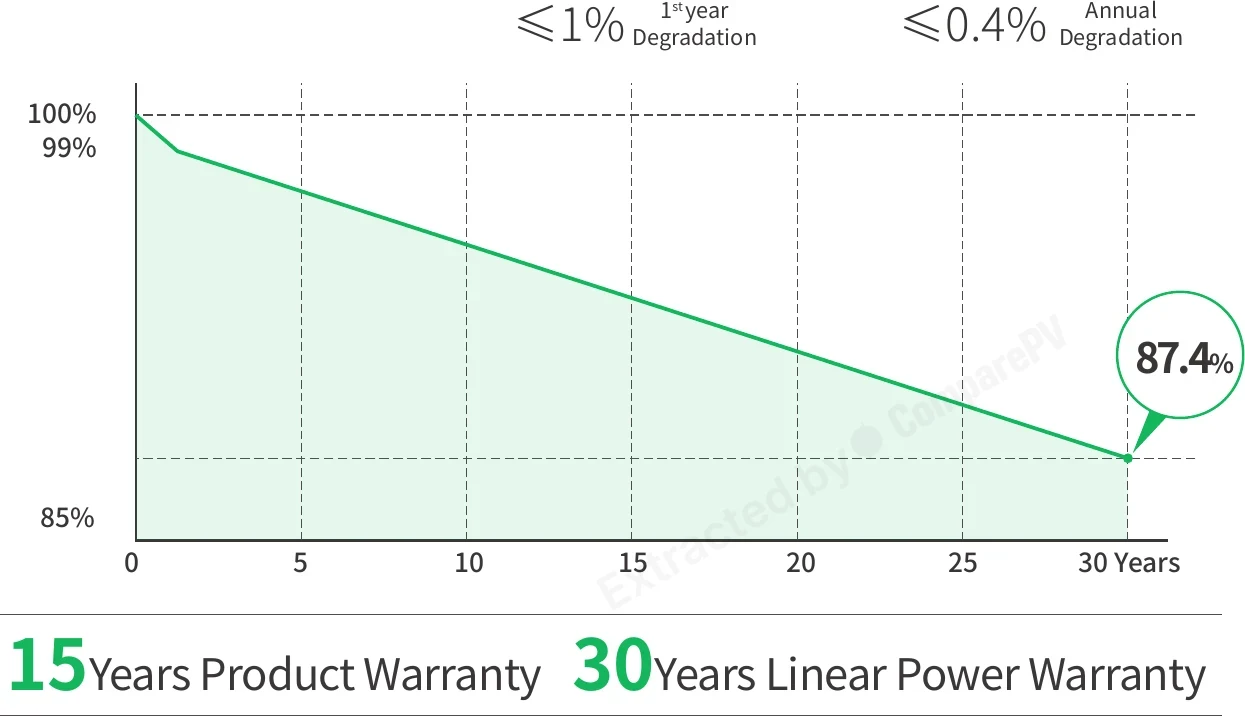
End-of-warranty output 87.4 % Equals 424 W guaranteed
Degradation 1.00 → 0.40 % First year, then annual

Datasheet charts

Open datasheet PDF

Measured curves published by Solarspace in this model's datasheet. A chart carrying a wattage was measured on that variant alone - only the ones that describe 485 Wp appear here. The rest cover the whole series.
Simulations

Live - change any input
Lifetime output & value
30 years at 1200 kWh/kWp/year and €0.50 per kWh
Power in year 30
-
Lifetime energy
-
Energy value
-
With bifacial gain
-

Degradation from this panel's own datasheet figures. No inverter, soiling or shading losses.

Heat losses
-0.290 %/°C against a segment median of -0.290
-
Bifacial gain
Rear gain over light concrete: -
-

Model: bifaciality × albedo × 0.6 view factor. A first-order estimate, not a yield simulation.

Filter these
Size
Panel Power Eff. Temp. Weight Difference
Solarspace SS8-60HD-485N 485 W 22.40% -0.290 25.0 kg You are here
LR7-54HJD-510M 510 W 25.00% -0.240 23.5 kg +25 W, cooler, +2.6 pp
AIKO-A495-MCE54Mw 495 W 24.80% -0.260 21.0 kg Cooler, lighter, +2.4 pp
LR7-54HJD-505M 505 W 24.70% -0.240 23.5 kg +20 W, cooler, +2.3 pp
AIKO-A490-MCE54Mw 490 W 24.50% -0.260 21.0 kg Cooler, lighter, +2.1 pp
LR7-54HJD-500M 500 W 24.50% -0.240 23.5 kg +15 W, cooler, +2.1 pp
CIPRO-TN9C54M-500W 500 W 24.50% -0.260 21.4 kg Cooler, lighter, +2.1 pp
SS8-60HD-470N 470 W 21.71% -0.290 25.0 kg -15 W, -0.7 pp
SS8-60HD-475N 475 W 21.94% -0.290 25.0 kg -10 W, -0.5 pp
SS8-60HD-480N 480 W 22.17% -0.290 25.0 kg -0.2 pp
SS8-60HD-490N 490 W 22.63% -0.290 25.0 kg +0.2 pp
SS8-60HD-495N 495 W 22.87% -0.290 25.0 kg +10 W, +0.5 pp
LR7-60HVH-560M 560 W 24.80% -0.260 25.0 kg +75 W, cooler, +2.4 pp
LR7-60HVH-555M 555 W 24.60% -0.260 25.0 kg +70 W, cooler, +2.2 pp
LR7-60HVHL-550M 550 W 24.40% -0.260 16.3 kg +65 W, lighter, +2.0 pp
JAT60S40-540/LR 540 W 24.40% -0.260 23.5 kg +55 W, cooler, +2.0 pp
GK-5-60HG-540M 540 W 24.40% -0.260 23.3 kg +55 W, cooler, +2.0 pp

Found 746 panels of the same or similar size to this one, within ±10 mm. See them here Found 755 panels of the same or similar size to this one, within ±25 mm. See them here Found 916 panels of the same or similar size to this one, within ±50 mm. See them here Found 1503 panels of the same or similar size to this one, within ±100 mm. See them here

Common questions

6 answered
What does N-type cell technology mean in the Solarspace SS8-60HD 470-495N series and why is it better than PERC?
N-type cells used in the SS8-60HD 470-495N series are free from LID (Light Induced Degradation), which affects older P-type PERC modules. This results in a lower annual degradation rate and sustained higher efficiency throughout the panel's service life. Over the 30-year power warranty period, this translates into meaningfully higher total energy production compared to conventional PERC technology.
Is the Solarspace SS8-60HD series suitable for a roof with chimneys or dormers?
Yes, the half-cut cell architecture used in this series splits cells into two independent halves, so shading from a chimney or dormer limits losses only to the shaded cells rather than the entire module. This is a key advantage for installations on typical urban rooftops or east-west orientations where uniform irradiance across the full panel surface is difficult to achieve.
What is the warranty on Solarspace SS8-60HD 470-495N panels?
Solarspace provides a 15-year product warranty covering manufacturing defects and a 30-year linear power warranty for the SS8-60HD 470-495N series. Thanks to N-type technology with a lower annual degradation rate than PERC modules, the panel should retain well above 80% of its rated power output of up to 495 Wp after 30 years of operation.
Does the bifacial design make sense on a pitched roof with dark roof tiles?
The bifacial design delivers the greatest gains in ground-mounted or flat-roof installations where the rear side collects light reflected from a light-colored surface or ground. On a steep pitched roof with dark tiles, the bifacial gain is minimal. In such conditions, the decisive factors are the high front-side efficiency and N-type cell technology, both of which the SS8-60HD series delivers regardless of roof type.
What installations is the Solarspace SS8-60HD 470-495N series recommended for — residential, commercial, or utility-scale?
The SS8-60HD 470-495N series is versatile: power output up to 495 Wp and an IP68 ingress protection rating make it suitable for residential rooftop systems, commercial installations on warehouses, and utility-scale PV farms alike. Solarspace is a Tier 1 manufacturer, which simplifies bankability assessments and accelerates due diligence for larger commercial or industrial projects.
Do Solarspace SS8-60HD panels generate energy on cloudy days and in low-light conditions?
Yes, the anti-reflective coating on the front glass improves absorption of diffuse radiation, resulting in better energy yield under overcast skies. N-type technology also lowers the temperature coefficient of the cells, meaning the module loses less efficiency during hot summer days compared to standard P-type PERC panels. Together, these features improve annual energy yield, particularly in climates with significant cloud cover.
Add to compare
