Meyer Burger MB_TG120AyB_375

MB_TG120AyB_375

375 Wp HJT Bifacial 90%
ComparePV verdict

Middle of its segment, modest efficiency

Rank 10,140 of 14,005
Compare panels Datasheet PDF
Power (Wp)
375
Typical for its class
Efficiency (%)
20.40
Weak · bottom 16%
Density (Wp/m²)
203.9
Weak · bottom 16%
Temp (%/°C)
-0.259
Typical · median -0.259
Weight (kg)
24.4
Typical · median 22.8 kg
Warranty (yrs)
30
Typical · median 30 yrs

The Meyer Burger Glass series consists of glass-glass construction panels designed for maximum durability and stable operation over a long period. By combining heterojunction (HJT) technology with bidirectional (bifacial) operation, these modules can effectively utilize light from both sides, which is particularly important on bright roofs, during ground mounting, and in installations with high ground reflection. In practice, this translates to increased energy production under the same conditions without having to "inflate" parameters on paper.

The use of glass-glass construction improves resistance to moisture, temperature changes, and mechanical loads, which reduces the risk of yield losses due to material degradation over time. Another key feature is SmartWire (SWCT) technology, which enhances resistance to microcracks and helps maintain the module's high efficiency in real-world operation.

This solution is ideal for investors who want predictable returns and peace of mind for years - particularly in premium installations, in challenging locations, and where long-term durability is a priority, supported by a long product warranty for glass-glass.

Ranking

45 panels in the segment HJT 350-400 W
Metric This panel Median Position in segment Overall rank
Module efficiency 20.40% 20.90% Weak · bottom 16% 11,598
Power density 203.9 209.3 Weak · bottom 16% 11,634
Temperature coefficient -0.259 -0.259 Typical 480
Weight per kWp 65.1 59.2 Typical 13,045
Performance warranty 30 yrs 30 yrs Typical 21
Colour key Strong - top 25% Typical - middle 50% Weak - bottom 25%

Signals from the data

5 positive · 5 caution
Best for

Residential, commercial, hot-climate and shaded-installations.

Not ideal for

Tight roof space and roofs where every square metre has to count.

Watch-outs
20.40% module efficiency

Bottom 16% of the HJT 350-400 W segment, against a median of 20.90%.

203.9 watts per square metre

Bottom 16% of the HJT 350-400 W segment, against a median of 209.3.

What owners get
HJT cells with SmartWire technology

The combination of N-type heterojunction cells with patented SmartWire (SWCT) reduces cell shading losses by about 30% and delivers a lower temperature coefficient than conventional PERC cells, translating into higher energy yield at high temperatures and under low-irradiance conditions (early morning, overcast skies).

Bifacial glass-glass construction

The glass-glass build with bifacial cells captures light reflected off the ground, which is meaningful on light-colored roofs, ground-mount installations, or snow cover - without inflating datasheet parameters the way some backsheet modules do.

30-year product and power warranty

A 30-year product warranty and 30-year linear power warranty exceed typical terms from peer comparables - JA Solar (JAM60S21) and Phono Solar Twinplus generally offer 12-15 years product warranty and 25 years power warranty, i.e. 5-15 years less coverage.

Mechanical durability of glass-glass build

The dual-glass laminate (approx. 23.5 kg for the 385Wp variant) significantly limits moisture ingress and laminate degradation over time compared to glass-backsheet modules, directly supporting power stability over a 20-30 year service life.

Swiss engineering heritage

Meyer Burger, founded in Switzerland in 1953, was regarded as a Tier-1 supplier with manufacturing largely based on European silicon and quality standards higher than typical mass-market Asian producers.

Trade-offs
Production discontinued, manufacturer insolvent

The series was discontinued in 2025, and Meyer Burger filed for insolvency in Germany and Chapter 11 bankruptcy protection in the US after closing its Goodyear, Arizona and Thalheim, Germany facilities; manufacturing assets were sold to Waaree and Swift Solar in 2026. Enforcement of the 30-year product warranty and service support is highly uncertain under these circumstances.

Efficiency not segment-leading

Maximum efficiency of 21.2% trails comparable N-type modules - LG NeON R Prime reaches 21.5% and Phono Solar Twinplus 21.3% at the same 390 Wp maximum power, so HJT's technological edge does not translate into the highest efficiency in class here.

Higher glass-glass module weight

At approximately 23.5 kg for a 1722x1041x35 mm module (about 13 kg/m²), the panel is heavier than typical glass-backsheet modules of similar power, increasing roof structural requirements and installation labor, particularly on retrofit roofs.

Notes from the database
  • At 20.4% efficiency, this panel is on par with typical HJT 0-400W modules
  • At 203.9 W/m² power density, roof space requirements are typical for HJT 0-400W panels
  • At -0.26%/°C, hot weather performance is typical for HJT 0-400W panels
  • At 24.4 kg, this panel is 2.9 kg heavier than the HJT 0-400W median (21.5 kg) - more demanding for installation crews
  • Bifacial design (90% factor) captures reflected light - adds 4-14% yield on ground-mount or white roof

Specifications

Open datasheet PDF
Nominal power (Pmax) 375 Wp Nameplate at 1000 W/m², 25 °C
Module efficiency 20.40 % Weak Segment median 20.90%
Vmpp · Impp 38.00 V · 9.90 A Operating point at max power
Voc · Isc 44.60 V · 10.30 A Sizes the string length
Max system voltage 1500 V Longer strings than 1000 V modules
Dimensions 1767×1041×35 mm · 1.84 m² of roof
Weight 24.4 kg Typical Typical · median 22.8 kg
Cells 120 · HJT Monocrystalline
Bifaciality 90 % Rear output as a share of front
Coefficient Pmax -0.259 %/°C Typical median -0.259 of its segment
Coefficient Voc · Isc -0.234 · 0.033 %/°C
NOCT 43 °C At 800 W/m², 20 °C ambient
Product warranty 30 years Hardware defects only
Performance warranty 30 years Typical median 30 yrs · median 30 yrs
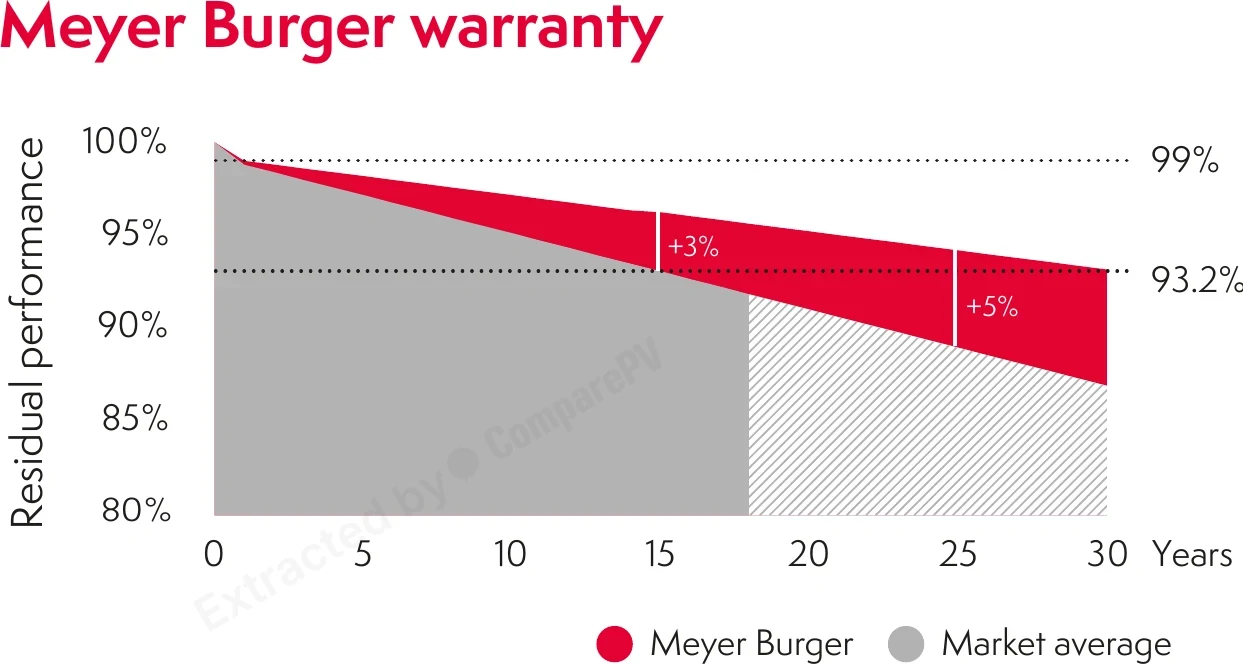
End-of-warranty output 93.2 % Equals 350 W guaranteed
Degradation 1.00 → 0.20 % First year, then annual

Datasheet charts

Open datasheet PDF

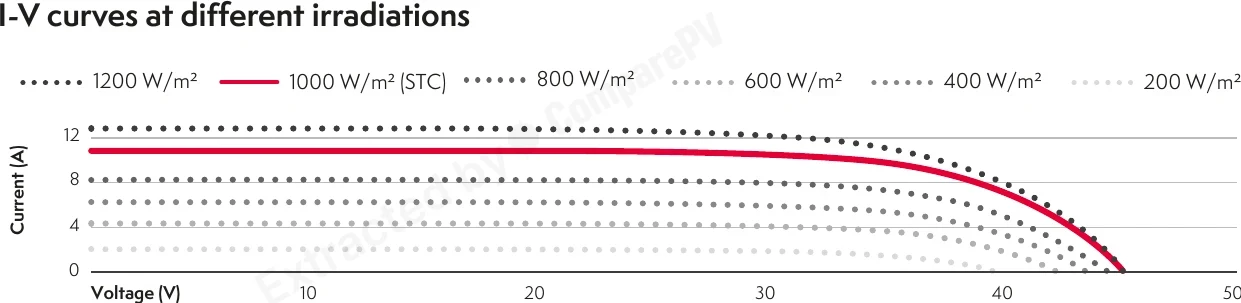
Measured curves published by Meyer Burger in this model's datasheet. A chart carrying a wattage was measured on that variant alone - only the ones that describe 375 Wp appear here. The rest cover the whole series.
Simulations

Live - change any input
Lifetime output & value
30 years at 1200 kWh/kWp/year and €0.50 per kWh
Power in year 30
-
Lifetime energy
-
Energy value
-
With bifacial gain
-

Degradation from this panel's own datasheet figures. No inverter, soiling or shading losses.

Heat losses
-0.259 %/°C against a segment median of -0.259
-
Bifacial gain
Rear gain over light concrete: -
-

Model: bifaciality × albedo × 0.6 view factor. A first-order estimate, not a yield simulation.

Filter these
Size
Panel Power Eff. Temp. Weight Difference
Meyer Burger MB_TG120AyB_375 375 W 20.40% -0.259 24.4 kg You are here
NS-330MH-80 330 W 23.15% -0.290 15.0 kg Lighter, +2.8 pp, -5 yr warranty
GKA210M340W 340 W 23.00% - 16.2 kg -35 W, lighter, +2.6 pp
GKA210M360W 360 W 23.00% - 16.2 kg -15 W, lighter, +2.6 pp
GKA210M380W (1/4*4*38) 380 W 23.00% - 17.1 kg Lighter, +2.6 pp
GKA210M400W (1/2*4*20) 400 W 23.00% - 18.0 kg +25 W, lighter, +2.6 pp
GKA210M400W (1/4*4*40) 400 W 23.00% - 18.0 kg +25 W, lighter, +2.6 pp
GKA210M380W (1/2*4*19) 380 W 23.00% - 17.1 kg Lighter, +2.6 pp
SPR-MAX3-400-COM 400 W 22.60% -0.270 19.0 kg Lighter, +2.2 pp, +10 yr warranty
SPR-MAX3-425-R 425 W 22.40% -0.270 21.2 kg +50 W, +2.0 pp, +10 yr warranty
MB_W120AyB_380 380 W 20.70% -0.259 19.7 kg Lighter, +0.3 pp, -5 yr warranty
MB_W120AyB_385 385 W 20.90% -0.259 19.7 kg Lighter, +0.5 pp, -5 yr warranty
MB_W120AyB_390 390 W 21.20% -0.259 19.7 kg Lighter, +0.8 pp, -5 yr warranty
LR7-54HJD-510M 510 W 25.00% -0.240 23.5 kg +135 W, cooler, +4.6 pp
AIKO-A495-MCE54Mw 495 W 24.80% -0.260 21.0 kg +120 W, lighter, +4.4 pp
LR7-54HJD-505M 505 W 24.70% -0.240 23.5 kg +130 W, cooler, +4.3 pp

Found 78 panels of the same or similar size to this one, within ±10 mm. See them here Found 283 panels of the same or similar size to this one, within ±25 mm. See them here Found 317 panels of the same or similar size to this one, within ±50 mm. See them here Found 4139 panels of the same or similar size to this one, within ±100 mm. See them here

Common questions

6 answered
Is the Meyer Burger Glass series still available for purchase?
The Meyer Burger Glass series has been discontinued and is no longer offered as new stock through regular distribution channels. Availability is limited to remaining inventory held by individual distributors. Meyer Burger has transitioned to a next-generation unified glass-glass platform, and the company's closure of its US manufacturing facility in May 2025 has significantly reduced global product availability across its entire lineup.
What warranty does the Meyer Burger Glass panel come with?
Meyer Burger Glass modules include a 30-year product warranty and a 30-year linear power output warranty. This extended coverage is directly tied to the glass-glass construction, which is far more resistant to moisture ingress and mechanical degradation than conventional glass-backsheet panels. The power warranty ensures predictable energy yields throughout the full operational lifetime of the installation.
What is HJT cell technology in the Meyer Burger Glass, and how does it compare to PERC?
HJT (heterojunction) cells combine crystalline silicon with an ultrathin amorphous silicon layer, resulting in a lower temperature coefficient than PERC cells — meaning less power loss on hot days. HJT modules also perform better in low-light conditions, exhibit near-zero LID (light-induced degradation) after initial exposure, and maintain higher efficiency over the full warranty period compared to standard PERC technology.
Does the bifacial design of the Meyer Burger Glass panels make sense for a typical residential rooftop installation?
The benefit of bifacial output depends heavily on surface albedo beneath the array. On a light-colored roofing membrane or a ground mount over bright gravel, the rear side realistically contributes an additional 5–15% of energy yield. On dark-colored tiles with minimal air gap, the gain is negligible. Bifacial technology delivers the greatest ROI in ground-mounted and commercial installations where rear-side irradiance conditions can be actively optimized.
What advantages does the glass-glass construction of Meyer Burger Glass offer over standard glass-backsheet panels?
The rear glass pane replaces the polymer backsheet, dramatically reducing moisture ingress into the laminate and lowering the risk of PID (potential-induced degradation). The structure also handles snow and wind loads better, and combined with Meyer Burger's SmartWire (SWCT) interconnection technology, it reduces the occurrence of cell microcracks. The result is a lower annual power degradation rate and more predictable energy production across the full 30-year warranty period.
What is the maximum power output of the Meyer Burger Glass panel, and which inverters is it compatible with?
The top variant in the series reaches 390 Wp under standard test conditions (STC). The modules support a system voltage of up to 1500 V DC, enabling longer strings and lower balance-of-system (BoS) cabling costs. The series is compatible with all major string inverters featuring MPPT inputs rated for 1500 V DC, including Fronius, SMA, Huawei, and SolarEdge. Always verify compatibility against the inverter manufacturer's current approved module list before system design.
Add to compare