Strong in heat, no clear weak spot
The JS Solar Athena (JSHI-M0) series is designed for maximum energy yield from a limited surface area - particularly in situations where every module on the roof counts. It features a unique half-cut cell architecture that improves performance under partial shading and reduces internal losses, effectively maintaining a more stable daily energy production. The use of HBC technology (with concealed connections on the back) enhances aesthetics and light utilization, while also simplifying installation to fit modern building designs. The Athena modules also offer PID resistance, which is important for installations exposed to harsh conditions and long DC strings. The entire system is completed by a sealed junction box with IP68 protection, ensuring long-term reliability on the roof. This makes it a good choice for single-family homes, small businesses, and investments where aesthetics, predictable energy yields, and durability in the Polish climate are important.
Ranking
Signals from the data
Residential, commercial and shaded-installations.
Top 2% of the PERC 400-450 W segment, against a median of -0.350. Ranked 2,165th in the whole database.
Top 8% of the PERC 400-450 W segment, against a median of 20.60%. Ranked 8,519th in the whole database.
Top 11% of the PERC 400-450 W segment, against a median of 206.2.
The half-cut cell design (108 cells) splits the module into two independent halves, reducing resistive losses and improving performance under partial shading. The HBC (Hidden Busbar Connection) technology eliminates visible solder busbars, cutting optical losses by approximately 0.5–1% versus conventional busbar designs while enhancing module aesthetics.
The Athena series' peak efficiency of 22% matches peer SunLink SL5M108 and nearly matches VSUN N-108MH-BW (22.02%), and clearly outperforms Silfab Elite (21.4%). This delivers comparable energy yield per roof area without the price premium typically associated with Tier-1 manufacturers.
Verified resistance to Potential-Induced Degradation (PID) is critical in systems with long DC strings (voltage >1000 V), common in three-phase residential and small commercial installations. Unmitigated PID can cause cumulative power losses of up to 30% over the module's operational lifetime.
An IP68 ingress protection rating ensures the junction box withstands continuous water immersion — a meaningful reliability factor in the Polish climate with heavy rainfall and prolonged snow coverage. This is a premium-tier specification not universally offered in this power and price segment.
Five power variants spaced 5 Wp apart allow precise MPPT window matching for the string inverter without power mismatch losses. This is a practical advantage in residential and small-commercial installations where the total number of modules per string is limited.
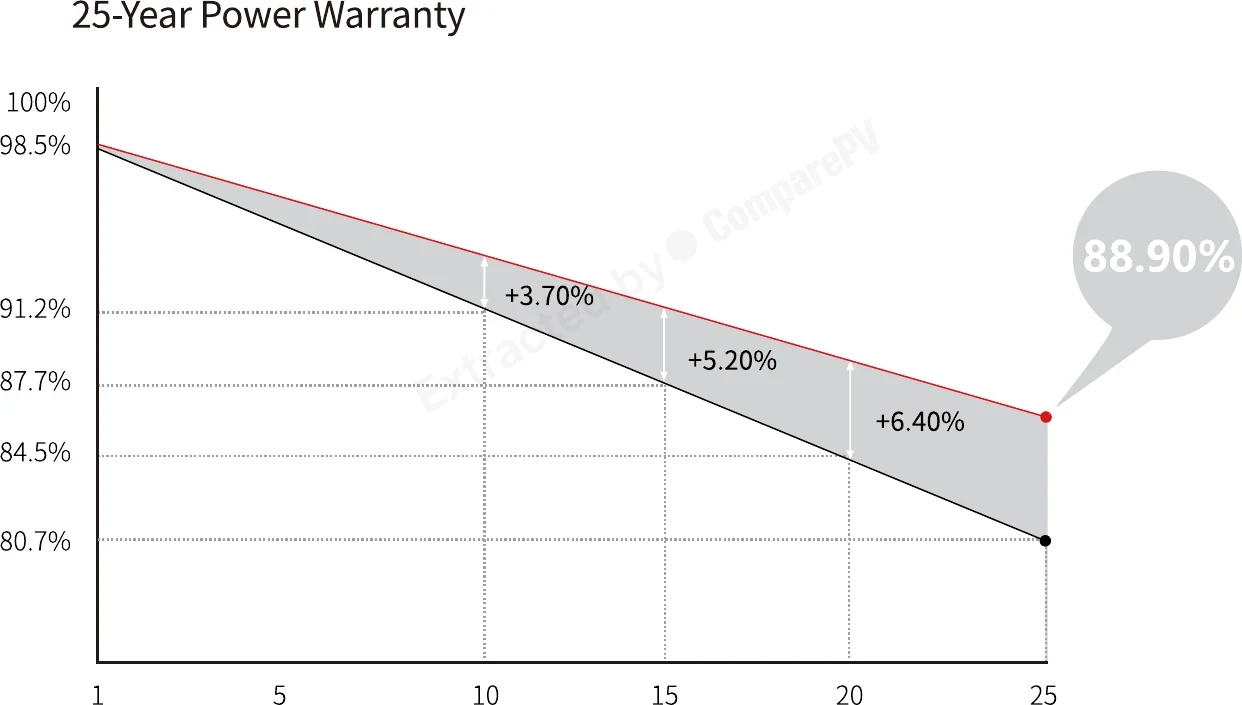
P-type PERC cells exhibit Light-Induced Degradation (LID) of 1.5–3% in initial weeks of operation and an annual degradation rate of ~0.6–0.8%/yr, compared to TOPCon n-type modules at <0.5% LID and ~0.4–0.5%/yr annual degradation. After 25 years, PERC retains approximately 82–84% of rated power versus 85–87% for TOPCon — a residual power difference of ~13–22 Wp for a 430 Wp module. The market shift from PERC to TOPCon accelerated significantly in 2024–2025.
JS Solar is absent from the BNEF Tier-1 bankable manufacturers list (Q1 2026), as confirmed by the product context (tier_1_bankable: false). This limits eligibility for non-recourse bank financing on commercial projects and may disqualify the series from institutional or corporate tenders requiring a bankable manufacturer guarantee.
The physical defect warranty of 15 years falls short of the 25-year product warranty offered by Silfab Elite (with online registration) and the emerging premium market standard. Since installations in Poland typically operate for 25–30 years, any physical module failure after year 15 shifts full replacement cost to the system owner.
- 21.3% module efficiency - 0.7pp better than the PERC 400-450W median of 20.6%
- At 212.5 W/m² power density, this panel generates 6.3 W/m² more per unit area than PERC 400-450W median (206.2 W/m²)
- At -0.29%/°C (vs median -0.35%/°C), loses ~2% less power in hot conditions
- 20.8 kg weight - 1.2 kg lighter than PERC 400-450W median (22.0 kg), reducing installation effort
- Ranked #8519 out of 14005 panels for efficiency in the database
Specifications
Datasheet charts
Measured curves published by JS Solar in this model's datasheet. A chart carrying a wattage was measured on that variant alone - only the ones that describe 415 Wp appear here. The rest cover the whole series.
Simulations
Degradation from this panel's own datasheet figures. No inverter, soiling or shading losses.
Alternatives






Found 1783 panels of the same or similar size to this one, within ±10 mm. See them here Found 1914 panels of the same or similar size to this one, within ±25 mm. See them here Found 3392 panels of the same or similar size to this one, within ±50 mm. See them here Found 3970 panels of the same or similar size to this one, within ±100 mm. See them here