Efficiency leader, no clear weak spot
The Heckert Solar ZEUS 1.0 series was designed for maximum energy yield in situations where long-term predictability is key - whether on residential rooftops or in commercial installations. These are bifacial glass-glass modules that can utilize light from both sides, including the rear, making them particularly effective in environments with reflected light from bright surfaces, gravel, or roofing membranes. The use of n-type TOPCon cells helps to minimize typical performance losses over time and improves performance in challenging conditions.
In practice, the ZEUS 1.0 addresses two common problems for investors: reduced power output in hot weather and energy shortages on cloudy days. This is achieved through a low temperature coefficient and good performance in low-light conditions. Furthermore, the double-glass construction increases resistance to loads and microcracks, resulting in high durability and stability. This is a sensible choice for those who want better quality than standard glass-film modules, without compromising on aesthetics and reliability.
Ranking
Signals from the data
Residential, commercial and hot-climate.
Top 17% of the TOPCon 400-450 W segment, against a median of 22.00%.
Modules are produced at facilities in Chemnitz and Langenwetzendorf (Thuringia), ensuring full supply-chain traceability and zero geopolitical exposure linked to Asian imports. In the context of ongoing EU tariff debates and potential Chinese supply disruptions, this is a tangible operational advantage for installers and project developers.
Heckert Solar provides a 30-year warranty on both the product and power output — whereas peer comparable Q.TRON BLACK (Q-Cells) offers a standard 25-year performance guarantee. The longer warranty directly lowers LCOE and simplifies long-term project financing.
N-type TOPCon cells deliver a temperature coefficient of Pmax of approximately -0.28 %/°C (confirmed for the ZEUS series), translating to ~17% lower thermal losses than typical PERC cells (-0.34 %/°C). The bifacial glass-glass structure enables additional rear-side energy yield — up to ~20% at high-albedo surfaces such as light-colored gravel or TPO membranes.
ZEUS 1.0 achieves 22.3% module efficiency, matching Q-Cells Q.TRON BLACK 445W (22.3%) — a direct Tier-1 rival — and clearly outperforming SunEvo SE6-46SC 445W (21.4%) and Solitek SOLRIF D Satin 445W (22.06%). The 5% power-density advantage over SunEvo is particularly relevant for constrained roof areas.
Certified for snow load up to 8,100 Pa and wind load up to 2,400 Pa, with resistance to ammonia, salt mist, and PID degradation. Eliminating the rear EVA backsheet removes the primary moisture ingress path, statistically reducing microcrack risk and encapsulant discoloration over the module lifetime.
Heckert Solar does not appear on the BNEF Tier-1 module manufacturer list (Q1 2026), which is required by many banks for financing projects above 1 MWp. For residential prosumer installations this is irrelevant, but it may be a blocker for commercial projects with institutional debt financing where counterparties mandate BNEF-listed suppliers.
The ZEUS 1.0 series offers only one power variant at 445 Wp, with no higher or lower options. Unlike Q-Cells Q.TRON BLACK — available across a wider power range (405–445 Wp) — the lack of choice may limit string optimization flexibility and compatibility with inverters featuring a narrow MPPT window.
- At 22.3% efficiency, this panel is on par with typical TOPCon 400-450W modules
- Power density of 222.7 W/m² matches the TOPCon 400-450W median
- Temperature coefficient of -0.29%/°C matches the TOPCon 400-450W median
- At 24.5 kg, this panel is 2.5 kg heavier than the TOPCon 400-450W median (22.0 kg) - more demanding for installation crews
- Bifaciality factor of 80% can add 4-12% extra yield with reflective mounting surface
Specifications
Datasheet charts
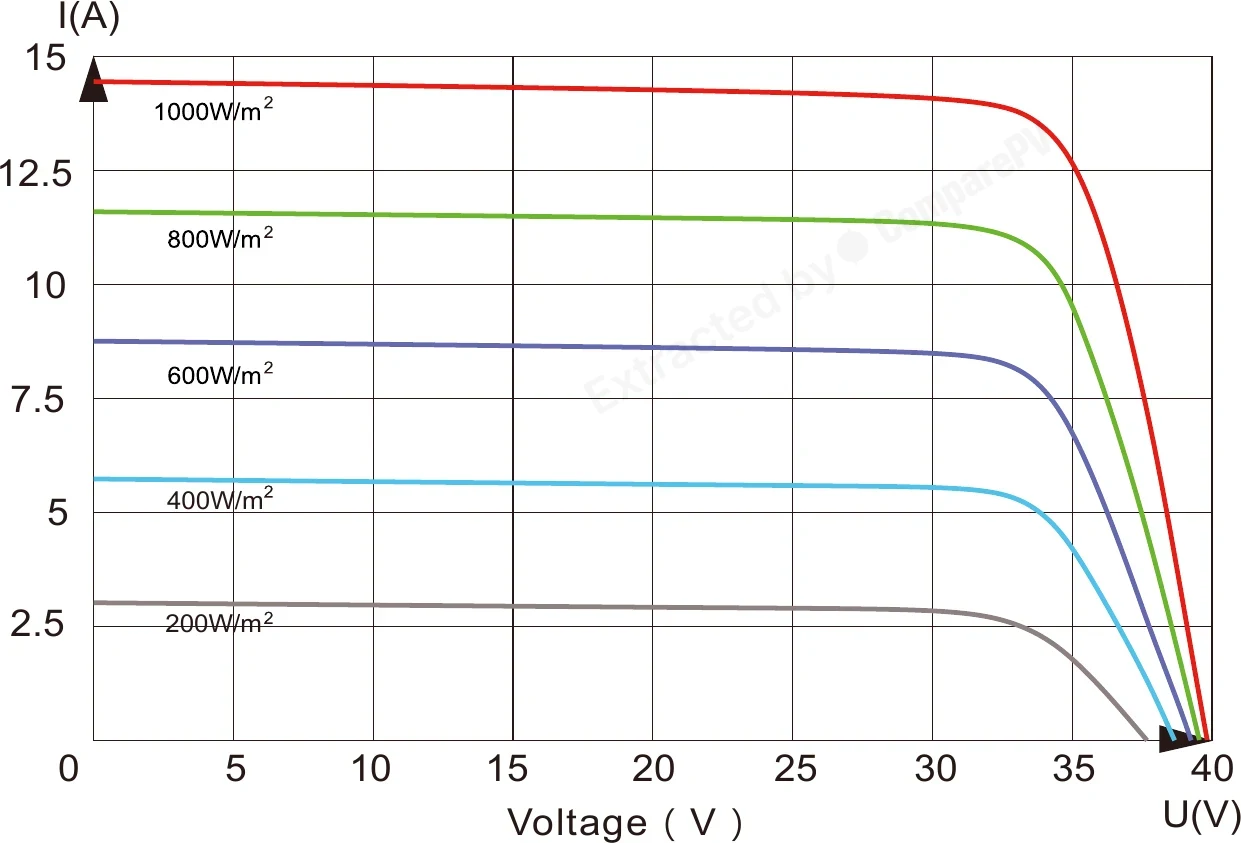
Measured curves published by Heckert Solar in this model's datasheet. A chart carrying a wattage was measured on that variant alone - only the ones that describe 445 Wp appear here. The rest cover the whole series.
Simulations
Degradation from this panel's own datasheet figures. No inverter, soiling or shading losses.
Model: bifaciality × albedo × 0.6 view factor. A first-order estimate, not a yield simulation.






Found 1395 panels of the same or similar size to this one, within ±10 mm. See them here Found 1425 panels of the same or similar size to this one, within ±25 mm. See them here Found 3614 panels of the same or similar size to this one, within ±50 mm. See them here Found 3962 panels of the same or similar size to this one, within ±100 mm. See them here