Middle of its segment, modest efficiency
The DAS-DH120NA series consists of advanced bifacial modules that utilize breakthrough N-type TOPCon cell technology, providing significantly higher efficiency than standard P-type solutions. Thanks to the bifacial dual glass construction, these panels effectively absorb light reflected from the ground, resulting in a real increase in energy yields even in challenging lighting conditions. A key differentiator is the minimal power degradation and excellent temperature coefficient, allowing the installation to maintain maximum performance even on hot days. The use of N-type technology eliminates the problem of the LID effect, guaranteeing long-term stability of electricity production and a faster return on investment. These modules are an ideal choice for those seeking the highest durability, as the double glass layer provides exceptional resistance to extreme weather conditions and corrosive factors such as ammonia or salt mist. DAS-DH120NA is perfect for both demanding ground-mounted installations and commercial rooftops, where maximizing power from limited space is crucial. Compared to the competition, this series offers an unrivaled balance between high conversion efficiency and mechanical strength, making it one of the safest choices in the premium segment for modern photovoltaics.
Ranking
Signals from the data
Commercial and hot-climate.
Tight roof space, roofs where every square metre has to count and weight-limited structures.
Bottom 18% of the TOPCon 450-500 W segment, against a median of 22.52%.
Bottom 18% of the TOPCon 450-500 W segment, against a median of 225.2.
Bottom 18% of the TOPCon 450-500 W segment, against a median of 52.2.
N-type TOPCon cells deliver a Pmax temperature coefficient of approximately -0.28%/°C (based on data for the closely related DAS-DH120ND series), a clear improvement over typical PERC cells (~-0.35%/°C). The absence of light-induced degradation (LID) ensures more stable output throughout the system's lifetime, with the greatest benefit realized during the first years of operation.
The bifacial dual-glass design captures an additional 5–15% of energy from reflected irradiance — up to 25–30% in typical ground-mounted installations with high-albedo surfaces. The double-glass laminate eliminates EVA degradation and provides resistance to chemical corrosion (ammonia, salt mist), making it particularly well suited for agri-PV and coastal installations.
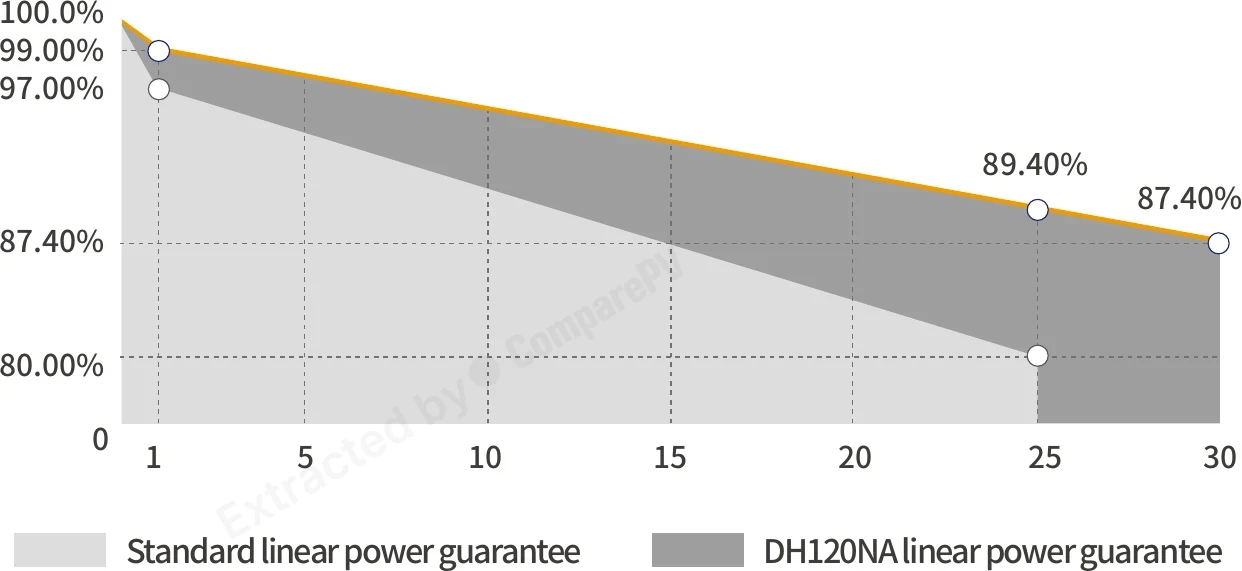
The manufacturer guarantees power output for 30 years, exceeding the 25-year standard common among mid-range competitors. For peer comparables (e.g., Horay Solar HS 182-120 TC), no publicly documented warranty period longer than 25–30 years has been recorded, placing the DAS-DH120NA at the upper boundary of the industry benchmark.
DAS Solar is listed on the BNEF Tier 1 Global PV Module Manufacturers list and received a Grade A rating in the PV ModuleTech Bankability Ratings Q3 2024 report. The series was also recognized as a Top Performer in the Kiwa PVEL 2024 PV Module Reliability Scorecard, providing independent, third-party validation of manufacturing quality.
The peak efficiency of 22.7% is on par with the best peer comparables: the Renesola RS4-470~490NX-E1 achieves 22.71%, as does the DAH Solar DHN-60X16/DG at 22.71%. The series matches segment leaders in power density, a critical advantage where rooftop or ground area is constrained.
The DAS-DH120NA (launched 2022) is officially designated as discontinued. This means no new supply is available directly from the manufacturer, capacity expansion is limited by the inability to source additional matching modules, and replacing a failed panel after several years may present significant compatibility challenges.
DAS Solar was founded in August 2018, meaning the company had only four years of operating history at the time this series was released in 2022. By comparison, Jinko Solar has been operating since 2006, LONGi since 2000, and Trina Solar since 1997. Despite its Tier 1 status, the shorter track record may be considered a risk factor when evaluating the credibility of the 30-year warranty.
In August 2024, the Shenzhen Stock Exchange rejected DAS Solar's IPO application, and in September 2024 reports emerged of a planned acquisition by CATL. The combination of a failed public listing and a potential change in ownership structure raises questions about the continuity of warranty obligations for a series that has already been discontinued.
- At 22.0% efficiency, this panel is 0.5pp below the TOPCon 450-500W median of 22.5%
- Power density of 220.1 W/m² is 5.1 W/m² below TOPCon 450-500W median (225.2 W/m²) - needs more roof space
- At -0.30%/°C, hot weather performance is typical for TOPCon 450-500W panels
- At 26.0 kg, this panel is 2.0 kg heavier than the TOPCon 450-500W median (24.0 kg) - more demanding for installation crews
- Bifaciality factor of 80% can add 4-12% extra yield with reflective mounting surface
Specifications
Datasheet charts
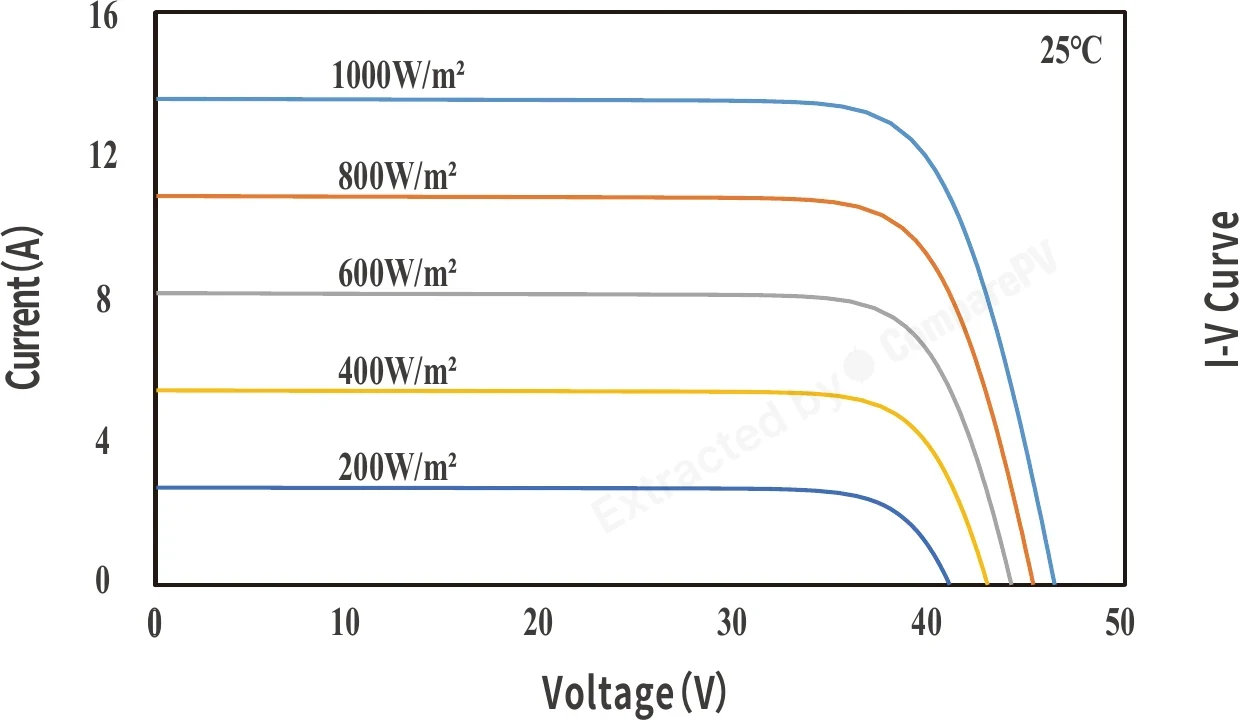
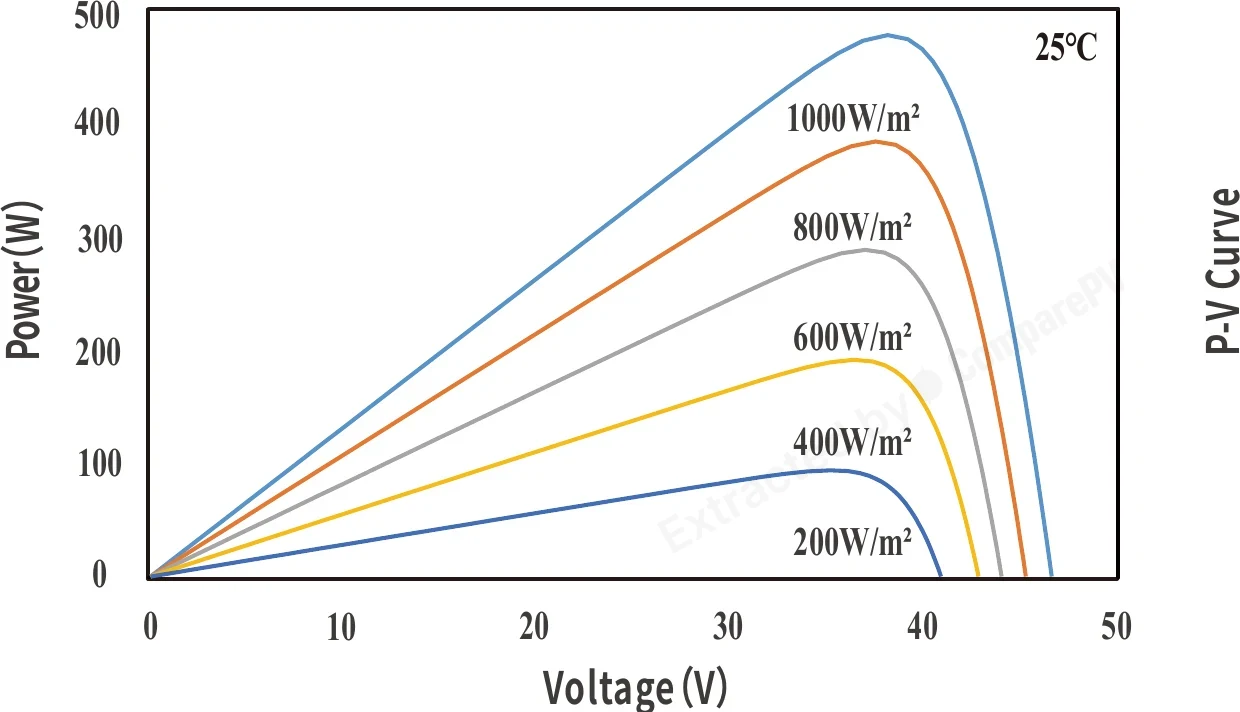
Measured curves published by DAS Solar in this model's datasheet. A chart carrying a wattage was measured on that variant alone - only the ones that describe 475 Wp appear here. The rest cover the whole series.
Simulations
Degradation from this panel's own datasheet figures. No inverter, soiling or shading losses.
Model: bifaciality × albedo × 0.6 view factor. A first-order estimate, not a yield simulation.





Found 725 panels of the same or similar size to this one, within ±10 mm. See them here Found 751 panels of the same or similar size to this one, within ±25 mm. See them here Found 870 panels of the same or similar size to this one, within ±50 mm. See them here Found 1499 panels of the same or similar size to this one, within ±100 mm. See them here