Strong in heat, no clear weak spot
The DAH Bifacial Double Glass Module (Black Frame) series is an advanced solution for investors seeking maximum efficiency from a limited area. The use of bifacial technology allows for the generation of additional energy from reflected radiation, which, combined with double tempered glass, drastically increases the mechanical durability of the modules. Thanks to the black frame, the panels gain a modern look that blends perfectly with dark roof coverings, without losing cell cooling parameters. A key differentiator is the high resistance to PID degradation and the LID phenomenon, which guarantees stable energy yields for decades. The glass-glass construction eliminates the risk of micro-cracks and protects the cells from moisture and aggressive external factors such as ammonia or salt mist. It is an ideal choice for ground-mounted installations, carports, and modern single-family houses, where every watt of power matters while maintaining impeccable aesthetics. Unlike standard monofacial modules, this series offers a better temperature coefficient, which translates into higher efficiency on hot days. By choosing this solution, the user receives a product resistant to extreme weather conditions, which effectively shortens the payback period thanks to a higher annual energy yield from the same mounting surface.
Ranking
Signals from the data
Residential, commercial and hot-climate.
Top 11% of the TOPCon 450-500 W segment, against a median of -0.290.
Top 22% of the TOPCon 450-500 W segment, against a median of 52.2.
DAH Solar has maintained BNEF Tier 1 status for multiple consecutive quarters, including Q1 and Q4 2025. This ensures full eligibility for project financing and insurance without additional supplier audits.
The manufacturer guarantees linear power output for 30 years, exceeding the 25-year standard offered by a significant portion of the market (e.g., Zonergy ZPM MH3-72). The extended warranty horizon directly improves IRR modeling for both utility-scale and prosumer projects.
N-type cells feature a Pmax temperature coefficient of -0.30%/°C, resulting in lower power losses on hot days compared to PERC technology (-0.35%/°C). At an ambient temperature of 35°C and a cell temperature of 65°C, this translates to approximately 1.5% higher instantaneous power output relative to a PERC module.
The dual tempered-glass laminate provides mechanical load resistance of up to 5,400 Pa (snow) and 2,400 Pa (wind) per datasheet specifications. It eliminates the risk of microcracks and moisture ingress, which is particularly critical for ground-mount and carport installations in temperate climates.
A bifaciality factor of ~80% enables an additional 10–20% energy gain from reflected irradiance at optimal ground albedo (light gravel, snow, light-gray membrane). In ground-mount installations over white gravel, this translates to a real-world annual energy yield gain of 5–10% compared to a monofacial module of equivalent STC power.
The maximum efficiency of the series reaches 22.5%, while direct peer comparables achieve 23.0% (Risen RSM96-11-440-460BNDG) and 23.02% (SunKean SKT440~460M12-96D4). The ~0.5 percentage-point gap translates to approximately 2–3% less power from an identical roof area, which can be a significant constraint in space-limited installations.
- At 22.5% efficiency, this panel is on par with typical TOPCon 450-500W modules
- At 225.4 W/m² power density, roof space requirements are typical for TOPCon 450-500W panels
- Temperature coefficient of -0.28%/°C matches the TOPCon 450-500W median
- 21.7 kg weight - 2.3 kg lighter than TOPCon 450-500W median (24.0 kg), reducing installation effort
- Bifaciality factor of 80% can add 4-12% extra yield with reflective mounting surface
Specifications
Datasheet charts
Measured curves published by DAH Solar in this model's datasheet. A chart carrying a wattage was measured on that variant alone - only the ones that describe 460 Wp appear here. The rest cover the whole series.
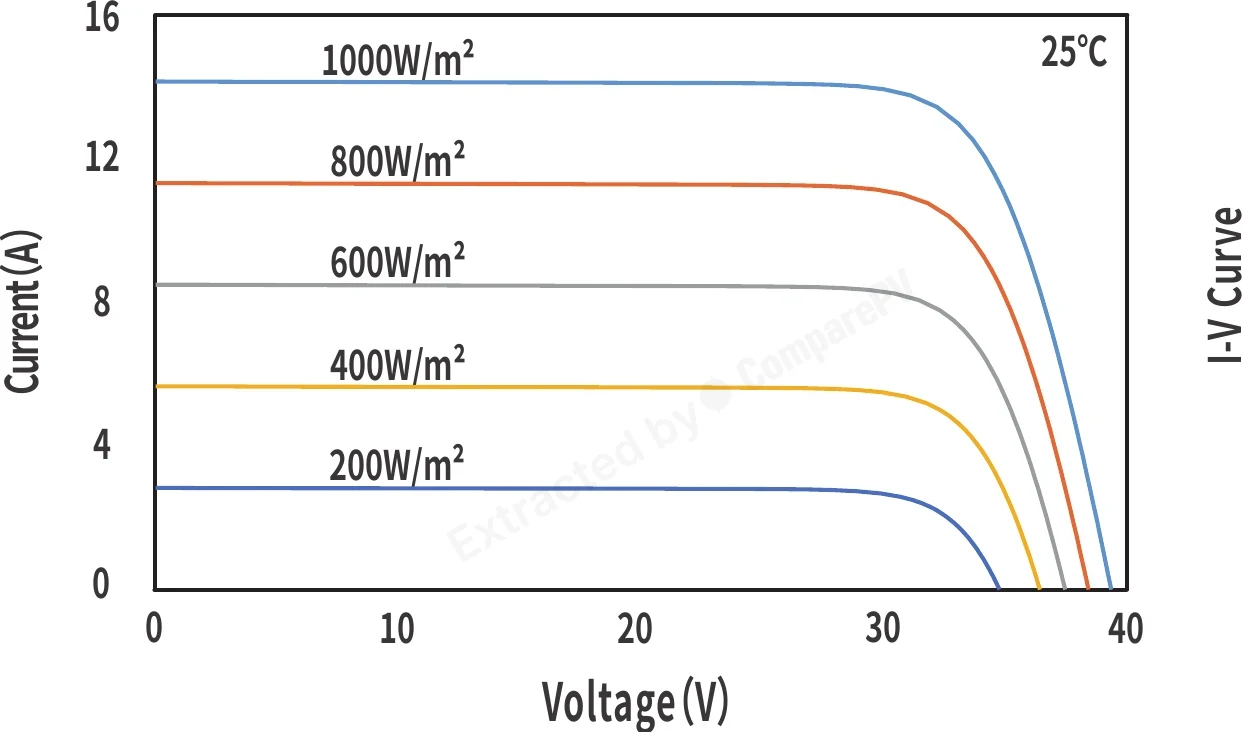
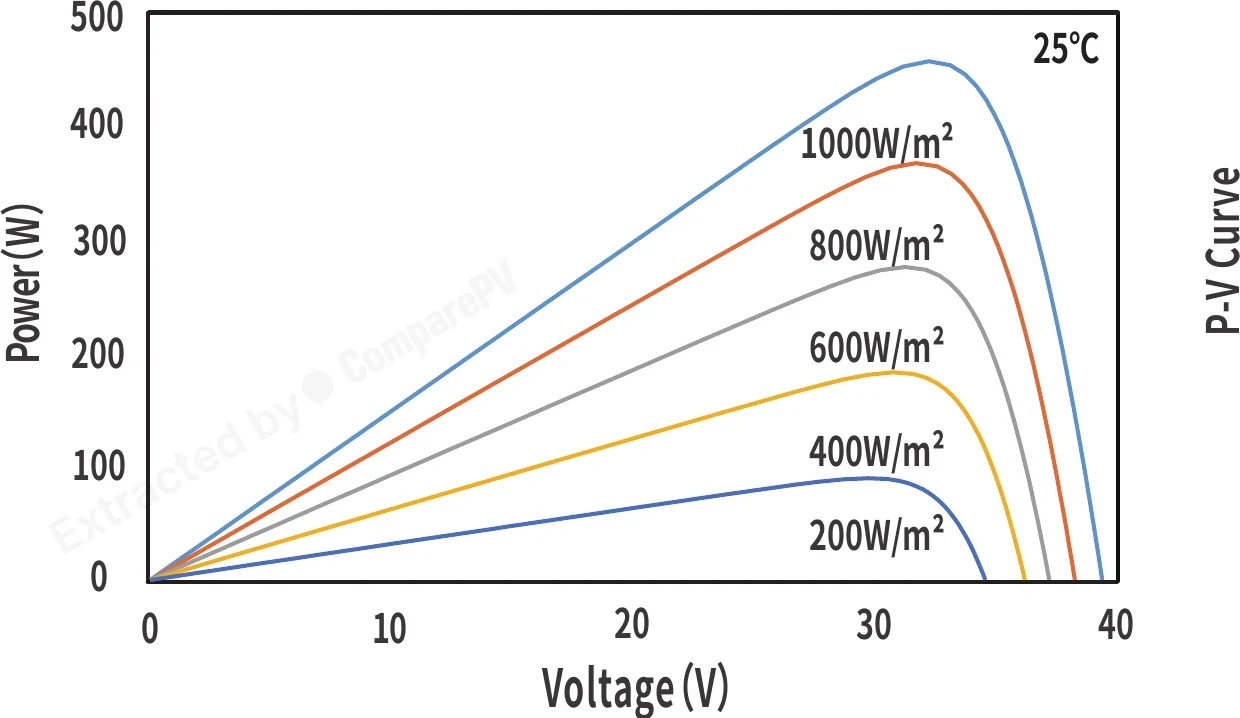
Simulations
Degradation from this panel's own datasheet figures. No inverter, soiling or shading losses.
Model: bifaciality × albedo × 0.6 view factor. A first-order estimate, not a yield simulation.



Found 197 panels of the same or similar size to this one, within ±10 mm. See them here Found 201 panels of the same or similar size to this one, within ±25 mm. See them here Found 1712 panels of the same or similar size to this one, within ±50 mm. See them here Found 4014 panels of the same or similar size to this one, within ±100 mm. See them here