Solid all-round for its segment
The DAH DHN-60R18/DG (500-520W) series are modules designed to maximize energy yield from the same roof or ground area, thanks to the combination of modern TOPCon type N cells and a bifacial design. The bifacial operation is particularly effective when there is a clear surface, high light reflection, or when the modules are mounted on a raised structure - energy "from the back" is no longer wasted.
The double-glass version increases stability and resistance to environmental factors, which will be appreciated by installations exposed to wind, moisture, or intense sunlight. From a practical point of view, this means a lower risk of microcracks and slower degradation of parameters over time, resulting in more predictable energy production.
The modules have a low temperature coefficient, so they maintain their performance even in hot weather, when many panels noticeably lose power. This is a good choice for prosumers, companies, and PV farms that are looking for high power density, a long operating life, and stable yields in Polish conditions.
Ranking
Signals from the data
Residential, commercial and hot-climate.
The Pmax temperature coefficient is -0.29%/°C, placing it among the lowest figures in the TOPCon segment (standard PERC cells typically range from -0.35 to -0.40%/°C). On hot summer days when module temperature exceeds 70°C, this advantage translates to a real-world gain of 3–5 W less power lost per 100 W of rated capacity compared to older cell technologies.
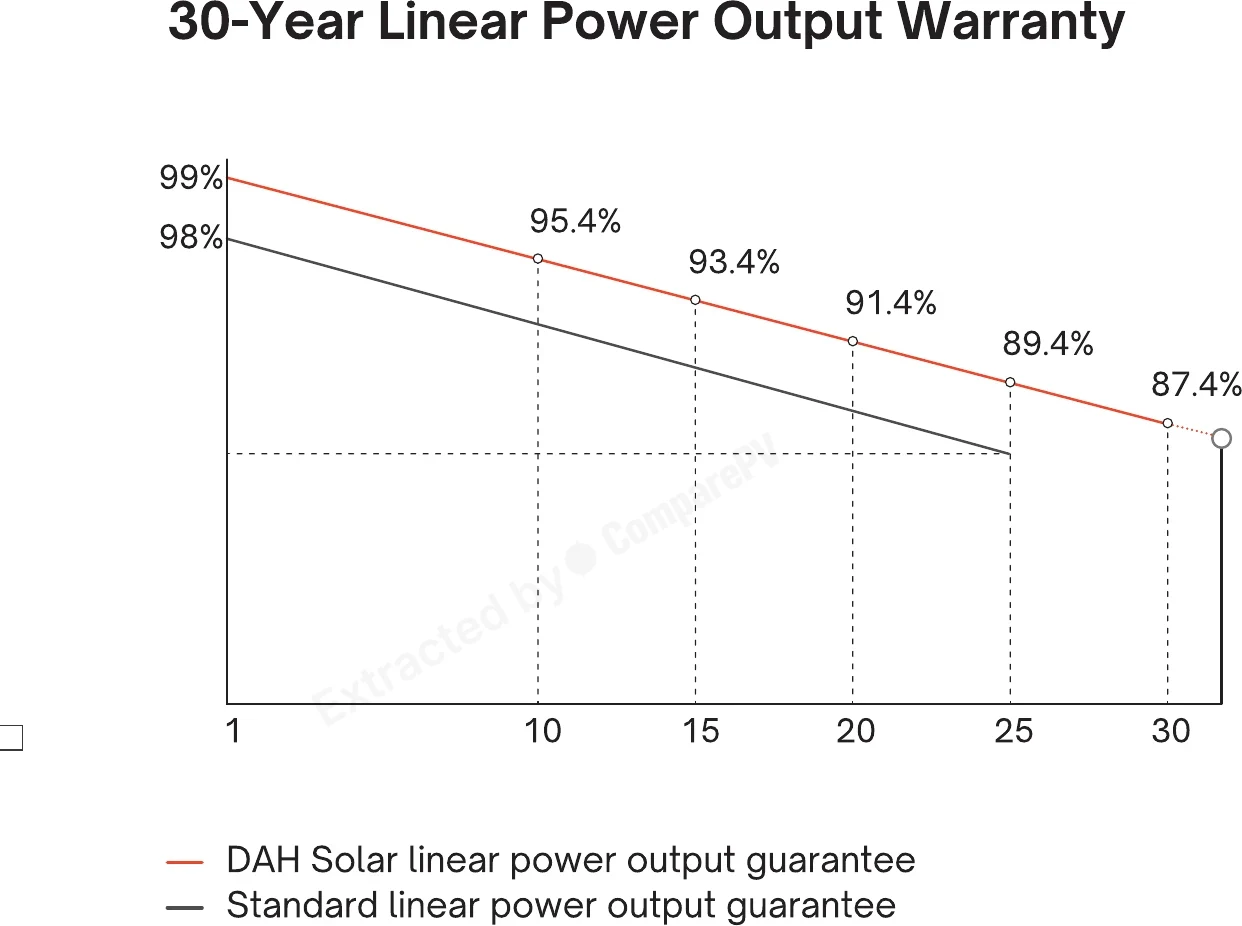
The manufacturer guarantees a minimum of 87.4% of rated power output after 30 years of operation (89.4% after 25 years). Leading competitors in the 500–520 Wp segment — such as the Silfab NTC — standardly offer a 25-year linear warranty, which at a comparable degradation rate provides a shorter investment protection horizon.
The glass-glass design (2+2 mm) delivers a snow load rating of up to 5,400 Pa and wind load resistance of up to 2,400 Pa, meeting the structural requirements of central and northern European climate zones. The elimination of a polymer backsheet removes the risk of delamination and swelling, reducing the likelihood of microcracks throughout the module's full service life.
DAH Solar has maintained continuous BNEF Tier 1 status for several consecutive years, including Q1, Q3, and Q4 2025 and Q1 2026. This designation enables access to project financing without additional credit enhancements and reduces manufacturer risk exposure for commercial installations and utility-scale PV plants.
N-type cells are inherently resistant to light-induced degradation (LID), a known performance loss mechanism in P-type/PERC technology. The bifacial configuration enables 5–15% additional energy harvest from the rear side over high-albedo surfaces — such as gravel, light-colored facades, or elevated racking systems — at no additional installation cost.
The series peaks at 23.0% module efficiency, while direct competitors in the same power class achieve 23.5% (TCL Zhonghuan HSM-BD60-LA Back Contact) and 23.8% (HT-SAAE HT54-18X(N)). On a 20 m² roof area, this gap translates to approximately 160–320 Wp less installed capacity compared to the most efficient alternatives available.
At 27 kg, the module is 3–5 kg heavier than typical single-glass panels in this power class (~22–24 kg). For large rooftop installations on older building stock or lightweight aluminum racking systems, this may necessitate additional structural load verification and increases overall installation labor costs.
- Efficiency of 22.6% matches the TOPCon 500-550W median
- At 225.5 W/m² power density, roof space requirements are typical for TOPCon 500-550W panels
- Temperature coefficient of -0.29%/°C matches the TOPCon 500-550W median
- Bifacial design (80% factor) captures reflected light - adds 4-12% yield on ground-mount or white roof
- #3905 for efficiency, #2165 for temperature performance out of 14005 panels
Specifications
Datasheet charts
Measured curves published by DAH Solar in this model's datasheet. A chart carrying a wattage was measured on that variant alone - only the ones that describe 510 Wp appear here. The rest cover the whole series.
Simulations
Degradation from this panel's own datasheet figures. No inverter, soiling or shading losses.
Model: bifaciality × albedo × 0.6 view factor. A first-order estimate, not a yield simulation.






Found 81 panels of the same or similar size to this one, within ±10 mm. See them here Found 94 panels of the same or similar size to this one, within ±25 mm. See them here Found 588 panels of the same or similar size to this one, within ±50 mm. See them here Found 1900 panels of the same or similar size to this one, within ±100 mm. See them here