Middle of its segment, modest efficiency
The DAH DHN-60R18/DG photovoltaic panel series sets completely new efficiency standards thanks to the use of an innovative, patented Full-Screen design. Unlike traditional modules, the front side of these panels is completely free of a protruding frame, allowing rainwater to freely wash away dust and any contaminants from the entire surface. This solution effectively eliminates the problem of sediment accumulation on the lower edge, which in classic installations often leads to cell shading, dangerous power drops, and the formation of hot-spots. The use of advanced N-type TOPCon cells guarantees excellent yields even in low, diffused sunlight and exceptionally low annual parameter degradation. Additionally, these modules are manufactured using Bifacial Double Glass technology, which not only significantly increases their mechanical resistance to harsh weather conditions but also enables additional energy production from the back side of the panel. It is an ideal solution for demanding roofs with a low inclination angle and modern commercial installations, where maintenance-free operation and maximized cost-effectiveness are priorities. By choosing the DHN-60R18/DG series, the user gains energy yields higher by up to 15 percent on an annual scale, while enjoying unique aesthetics and the highest reliability, confirmed by the manufacturer's extended warranty.
Ranking
Signals from the data
Residential, commercial and hot-climate.
Tight roof space, roofs where every square metre has to count and weight-limited structures.
Bottom 17% of the TOPCon 500-550 W segment, against a median of 22.73%.
Bottom 17% of the TOPCon 500-550 W segment, against a median of 227.4.
Bottom 25% of the TOPCon 500-550 W segment, against a median of 52.4.
The patented frameless front-edge design eliminates sediment retention along the module's bottom edge. In practice, this prevents hot spots caused by shading from accumulated soiling; on low-tilt installations (< 15°), this can translate into a +2–5% gain in annual energy yield compared to conventional framed modules under identical conditions.
The Pmax temperature coefficient is -0.29%/°C, while typical PERC modules range from -0.34 to -0.38%/°C. On hot summer days (e.g., 65°C cell temperature), this results in approximately 3 percentage points less power loss relative to PERC — a meaningful advantage given Poland's extended summer irradiance periods.
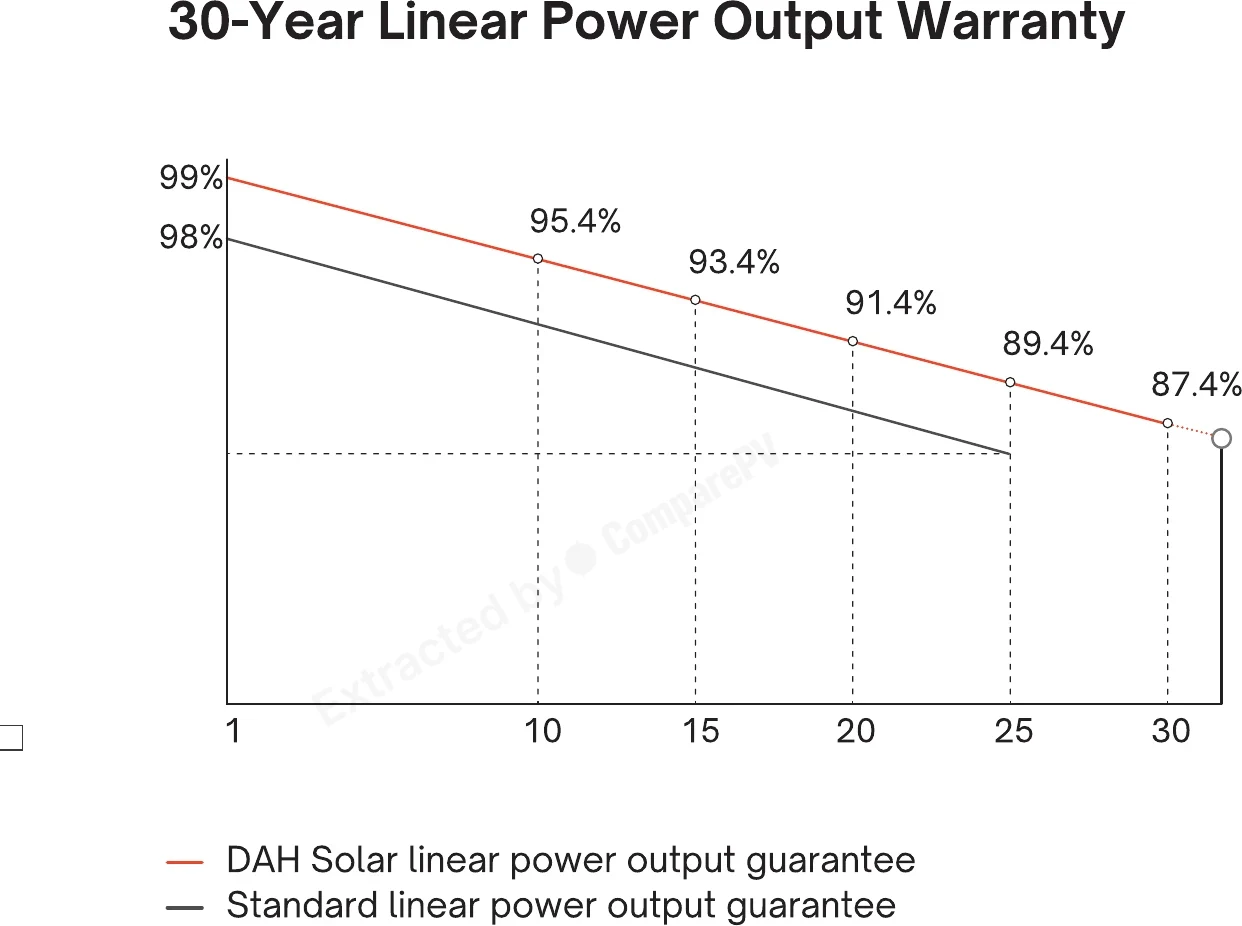
The manufacturer guarantees ≥89.4% of rated power after 25 years and ≥87.4% after 30 years. By comparison, the Silfab Commercial NTC (peer comparable) offers a standard 25-year warranty. The extended coverage directly improves project bankability and reduces risk in DCF models for commercial installations.
DAH Solar has maintained BNEF Tier 1 status continuously across all quarters of 2025 (Q1, Q3, and Q4 publicly confirmed). This designation is required by the majority of EU PV project lenders and reduces the cost of debt financing for commercial and utility-scale installations.
The dual-glass construction withstands snow loads up to 5,400 Pa and wind loads up to 2,400 Pa. Eliminating the front EVA encapsulant and using a glass backsheet removes the risk of PID degradation and backsheet delamination (snail trails) — particularly important for assets with extended service lives (>20 years without module replacement).
The maximum efficiency of 23.0% is lower than the HT-SAAE HT54-18X(N) (23.8%) and TCL Zhonghuan HSM-BD60-LA (23.5%) at the same 520 Wp rating. On roof areas where space is constrained (e.g., <30 m²), the DHN-60R18/DG series requires approximately 3–4% more area to achieve the same system output as the highest-efficiency peer comparables.
The module weighs 27 kg, owing to its dual-glass construction, versus ~21–23 kg for typical backsheet modules. On roofs with limited structural capacity (older buildings, lightweight industrial structures), an additional structural engineering assessment is required, adding approximately PLN 500–1,500 to the project cost per installation.
- Module efficiency of 22.1% is 0.6pp below average for TOPCon 500-550W panels (median: 22.7%)
- Power density of 221.1 W/m² is 6.3 W/m² below TOPCon 500-550W median (227.4 W/m²) - needs more roof space
- Temperature coefficient of -0.29%/°C matches the TOPCon 500-550W median
- 80% bifaciality enables rear-side power generation, boosting yield by 4-12% on reflective surfaces
- In the top 43% for efficiency among all TOPCon panels
Specifications
Datasheet charts
Measured curves published by DAH Solar in this model's datasheet. A chart carrying a wattage was measured on that variant alone - only the ones that describe 500 Wp appear here. The rest cover the whole series.
Simulations
Degradation from this panel's own datasheet figures. No inverter, soiling or shading losses.
Model: bifaciality × albedo × 0.6 view factor. A first-order estimate, not a yield simulation.






Found 81 panels of the same or similar size to this one, within ±10 mm. See them here Found 94 panels of the same or similar size to this one, within ±25 mm. See them here Found 588 panels of the same or similar size to this one, within ±50 mm. See them here Found 1900 panels of the same or similar size to this one, within ±100 mm. See them here